
Chāvdi - a tribute
A Zuihitsu that wants to grow up to be a koan
A couple of days ago, I attended a literary gathering in Thane (Mumbai) that was organised by the Padmashri Daya Pawar Pratishthān in tribute to the Marathi legend - the “People’s Poet” Narayan Surve. I went with a dear “Friend of Poetly”, poet, researcher and archivist Saranya Subramanian, founder of the incredible The Bombay Poetry Crawl . She had told me about the event, and we decided to go. Our shared interest in the urban, and in poetry, particularly in the context of Mumbai/Bombay/Bambai has led to several sparkling collaborations and heady discussions that problematise the notion of “Bombay poetry”. As we walk in the footsteps of the poets we love, and we read their poetry, perhaps the contentions and complexities in this chimeric category could be interrogated through our writing.
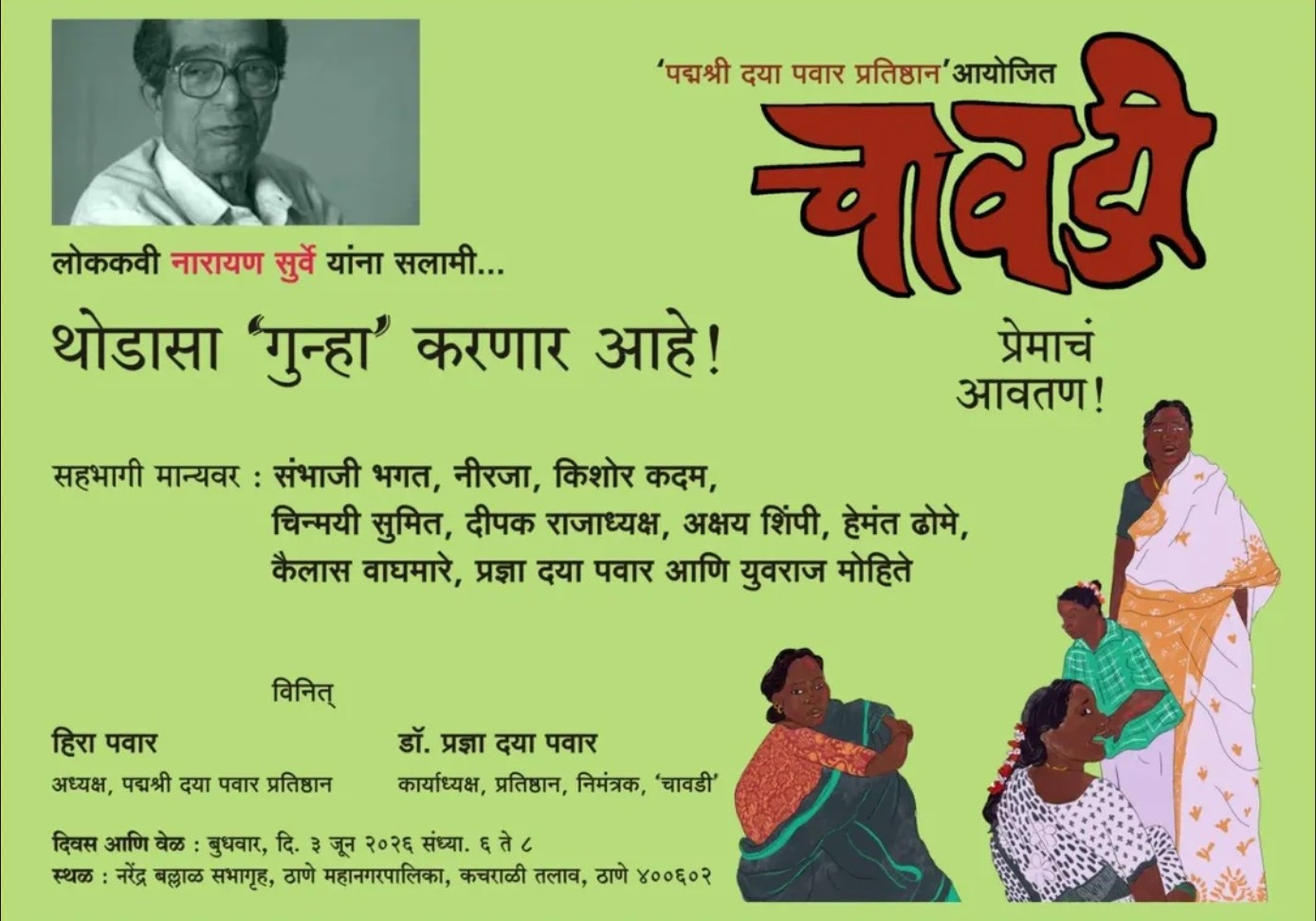
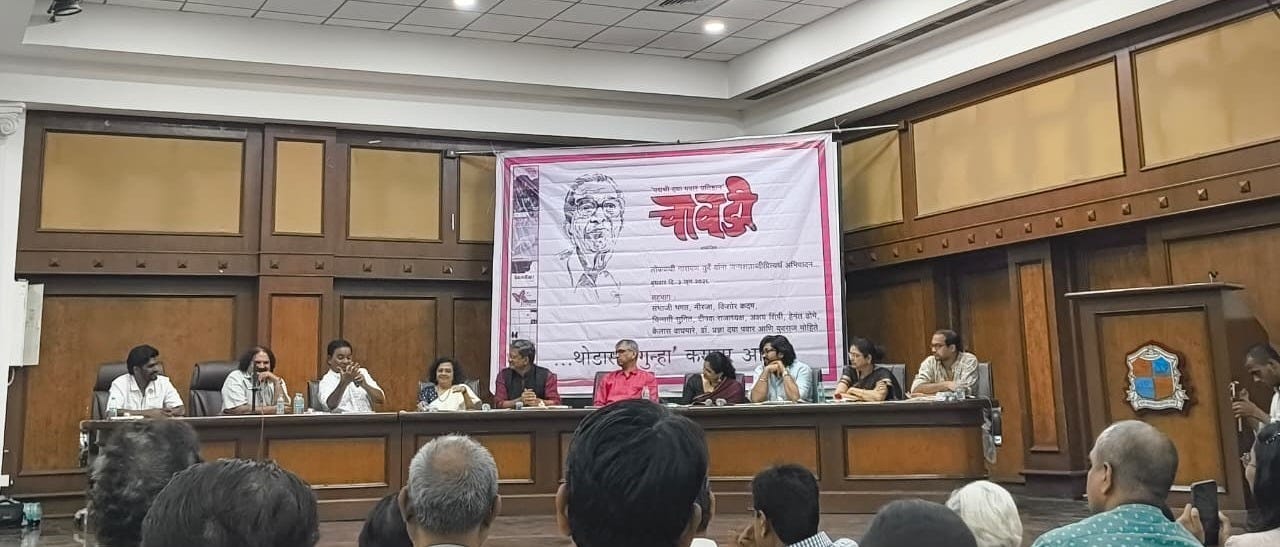
The event was superbly attended - a packed hall on a Wednesday evening is testament to the commitment of rasiks, activists, journalists, artists, intellectuals and scholars, who know and love the work of the lokshahirs, and of “lokkavi” Narayan Surve’s ideals. I felt something miraculous that evening - a community of people whose deep passion intertwined with a politics of freedom. The recitations, songs, and stories, curated by the mercurial Sutradhār Yuvraj Mohite, filled with collegiality, sharp satire, informed critique, and shared epiphanies, had us entranced for a couple of hours. In that room, I saw the flaring flags of Ambedkar and Marx, Krantikāri Jai Bhim, and Satrangi Salām.
But the thing that keeps coming back to me is the Golden Chain of poets, writers, and singers, the historical continuity of artists, from the last century (and before that) up until the present. This continuity emerged as a living, breathing entity that evening; in the dialogic imagination of the speakers, in their memories, in the timbre of their voices - at times trembling with emotion, and at times, strong as a foghorn - and in the intimate, shared stories of fights against censorship, struggles for the rights of workers, destitute, and women. This was the voice of experience. of having lived and seen, of the practice and art of education, organisation, and agitation. The powerful spectre of the “outlaw” and the “vate”, in their truest, most beautiful forms - those who looked beyond, who subverted the might of capital and tyranny - was standing tall before me, in the smoke and storm of those dancing words.
I wrote a Zuihitsu (that wants to be a koan) about the experience, in the context of varied pasts, presents, and futures of poetry.
This is for the organisers and speakers, inspired by the stories they shared: Sambhaji Bhagat, Pradnya Daya Pawar, Akshay Shimpi, Neeraja, Yuvraj Mohite, Kailas Waghmare, Chinmay Sumit & Deepak Rajyadhyaksha.
Chāvdi

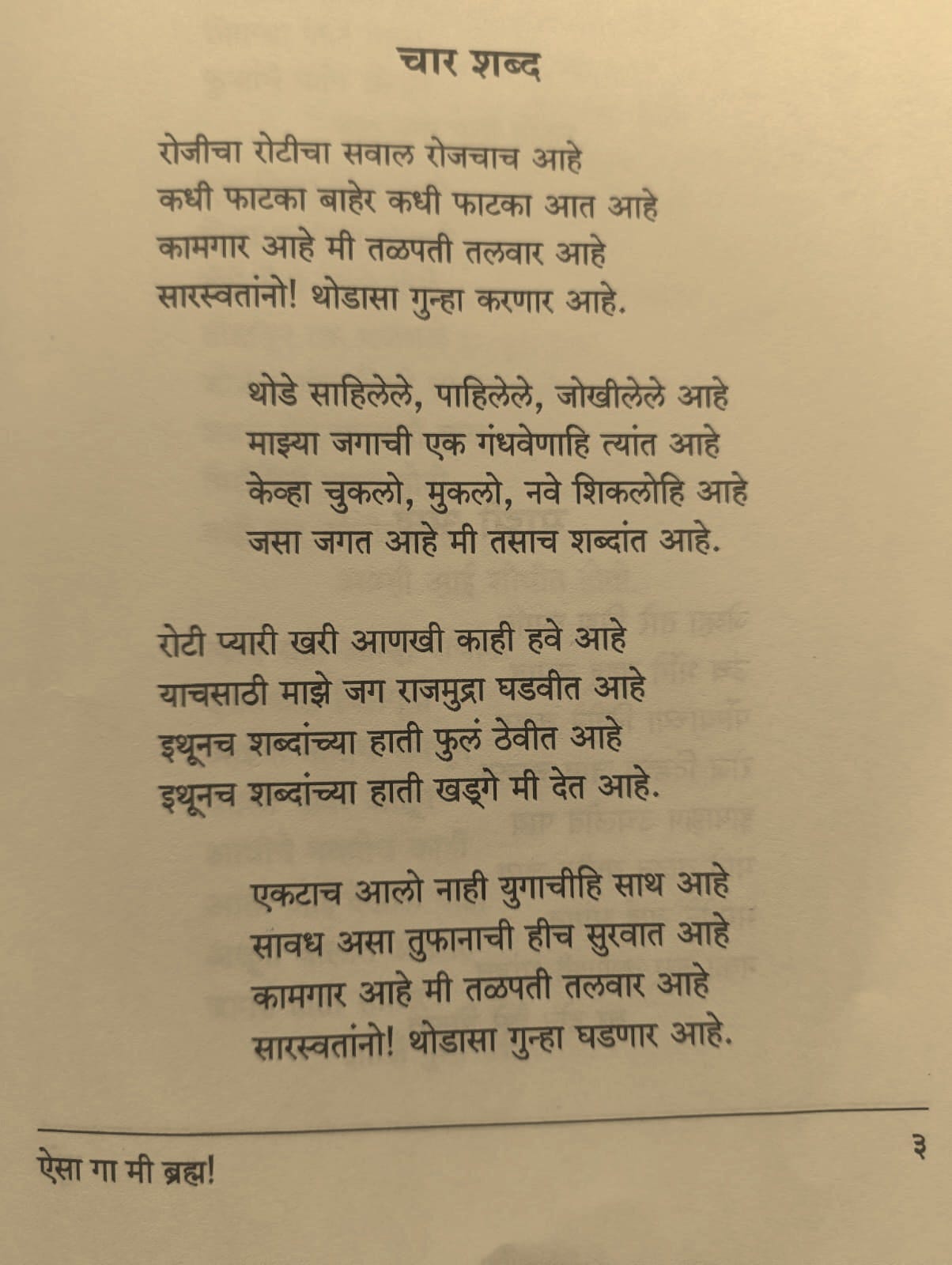
-  a tribute to Chāvdi, “Thoda Sa ‘Gunha’ Karnaar Aahe” – a gathering in the memory of Narayan Surve, presented by Padmashri Daya Pawar Pratishtan, on June 3rd, 2026 at Narendra Ballal Sabhagruh, Thane.


when the mallet hits the gong a sun is born. the sun that forks into moons in the lokshahir's eyes. bhakri and chalwal are roasted on the same tawa.

And his hair. like the unfurled wings of a falcon, ripples into the open mouths of those who are watching, with laughter and memory caught in their throats.

this is the chāvdi, the koodal, the meeting place. these are the horizons ahead of us. and they swell outwards in concentric circles extending beyond suvarna babasaheb's fogged up glasses, beyond surve master's mousy face upturned towards the clarion of progress. beyond the thief who turned poet when he stole into the poet's house.

The Writing On The Wall is an Apology. It's only mistake is that it is in verse. No government can contain the verse. It is the oldest joke in the world. to be in verse.

When the thief came to Ryokan's house, he found nothing. Ryokan was sitting outside cross-legged in the courtyard, looking up at the lone moon; naked, like the day he was born. His white robes were folded before him, a gift for the thief, lest he were forced to return empty handed. He looked at the disappointed youth with a sadness that split the night's inkblack pupil.
As the clouds cleared
the old monk
bathed in moonlight
quietly said:
I have nothing for you, earnest thief
If only
I could have gifted you
this silver moon.

In the bard's ululating voice, in the young turk's swaying lavani, in the journalist's reassuring interludes that fable into laughter, in the actor's sentimental bravado, in the prostitute's letter home, in the kabutar's companionship, in sur and desh, kaal and kaalokh, in the activitist's defiance of the censor, in the poster with half a sickle flapping in the breeze,
the comrade
arises.

Marx stands up and tells Mardhekar that his ovis aren't saucy enough. Lal Singh Dil flays his heart out, and shows Surve his palm on which is carved out, a crescent. As his words soar to the ceiling - the time waits to be reminded of its cyclicality.

In that room, oh what rooms were there, what rooms. When they sentenced him to death Bhagat Singh let out a great big guffaw. The room remembers. All rooms remember. war rooms, drawing rooms, rooms where desire goes to hide, where boredom turns inside out and becomes epiphany.

One room is all rooms. what rooms we sit in, where the song reverberates around a circular stage, decades curl like peeling plaster, and the second hand whirls back to 30 years, then 40, then 50. and we are born again in the translation of music
into time.

yesterday i understood the meaning of prayer. when one poet reads another, the bodies of all the other poets sitting at the round table become bells, a chorus of gongs. the ones who are not reading - they mouth what the reader speaks. possessed. and all their lips shape the message that slowly floats before them.

outside, the breeze rustles the leaves. a danger wind is coming, Surve master. and revolution is brewing right at the heart of government, at the epicentre, in the room
of power.

a poem is a switch. a deadman's switch. if it is triggered, it has the power to turn back time. a poem is prophecy turned inside out.
I hope the day is kind to you, and you are finding the space to rest
and to create.
Write to me @
aranyapadil@gmail.com - if you have any questions, queries, or comments. I will write back as soon as I find the space, and the time.
This newsletter and its associated activities are essentially a one-person enterprise.
If you like what you read, do consider ‘buying me a coffee’.